Hot Products


Waste PCB Recycling Process
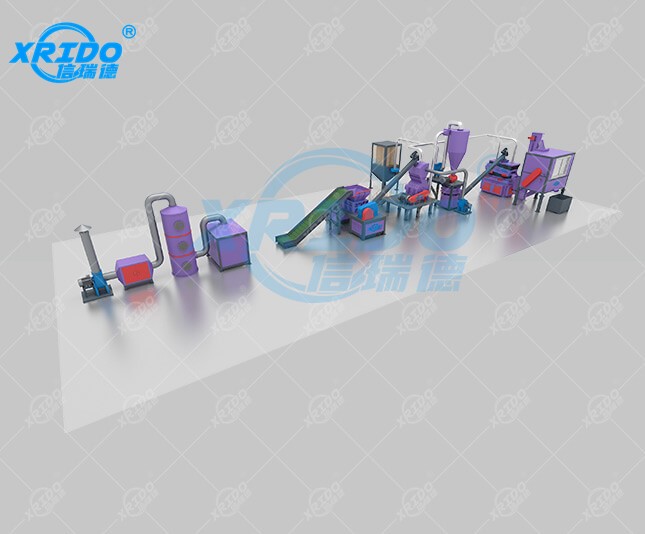
Waste PCB Recycling Process: Shredding → Coarse Crushing → Pulverizing → Airflow Screening → Vibration Separation → Environmental Treatment
1. Shredding Process: Waste PCB material is conveyed by a belt conveyor to a twin-shaft shredder, processing large-sized waste circuit boards into strips approximately 20mm wide to meet the requirements of the next coarse crushing process.

2. Coarse Crushing Process: After being shredded into strips, the material is conveyed by a belt conveyor to a coarse crushing machine for further processing into granular material of 10mm or smaller. The material is then evenly fed to a pulverizer by a screw feeder for further pulverization.
3. Pulverizing Process: This process further refines the granular waste circuit board material, achieving the separation of metals and non-metals to meet the requirements of subsequent separation and sorting processes.
4. Airflow Separation Process: This process utilizes the difference in specific gravity between non-ferrous metals and non-metals… The principle of airflow rotation centrifugal separation is used to initially separate and sort particulate materials of different sizes and specific gravities. Lighter, finer non-metallic materials are separated, packaged, and stored, while heavier metal and non-metal mixtures are further homogenized and concentrated, laying a good foundation for the next stage of fine separation.
5. Vibration Separation and Sorting Process: This process is a fine separation process, further separating the coarser metal and non-metal mixtures obtained from the initial selection process. The principle is that the reciprocating vibration of the screen surface at a certain frequency, combined with the downward blowing and upward suction of the airflow, continuously separates the metal powder. The vibration frequency and airflow of this process are adjustable, so the purity of the metal powder can be improved according to customer requirements, with a purity of 98%.
The equipment primarily consists of crushing and separating equipment. During operation, it generates significant amounts of dust and exhaust gas. To prevent pollution of the production site and surrounding environment, the production line utilizes a sealed pipeline negative pressure material conveying system. Through an effective combination of cyclone separators, pulse dust collectors, and fans, dust and exhaust gas are collected systematically and uniformly treated for dust removal and purification, ensuring environmental compliance before being released into the atmosphere. Metal recovery rate: 93%–98%; average metal content of non-metallic powder: ≤2%–5%.