Hot Products


Waste Shredders for life
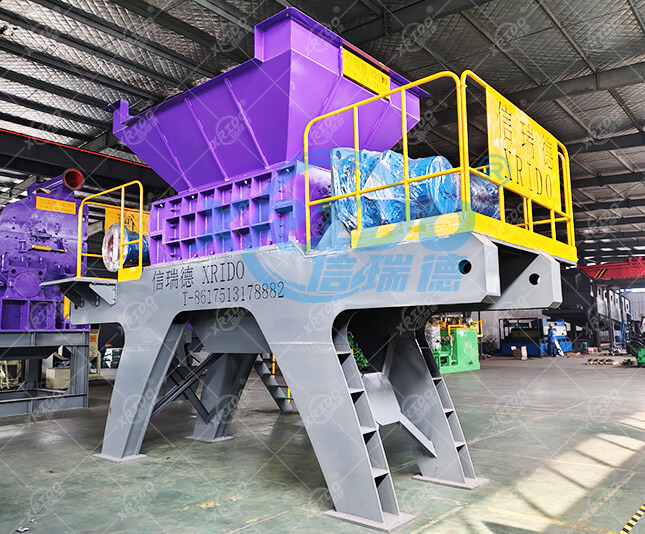
A waste shredder is a machine composed of a crushing roller system, a supporting housing, a feeding system, a power system, and an electronic control system. It is mainly used for crushing coarse and hard waste, reducing its volume to save space for transportation and recycling, such as waste tires, building materials, waste furniture, and electronic waste.
I. Classification of Waste Shredders: Waste shredders come in various shapes and sizes, with each manufacturer having its own unique design. However, based on actual production needs and specific shredding requirements, the internal rollers of waste shredders are basically divided into four types: single-shaft rollers, double-shaft rollers, four-shaft rollers, and coarse crushing rollers. Therefore, we can classify waste shredders into four categories: single-shaft waste shredders, double-shaft waste shredders (environmentally friendly and noiseless – popular equipment), four-shaft waste shredders (environmentally friendly and noiseless – popular equipment), and coarse waste shredders.

Below are different types of waste shredders: Classification of Waste Shredders:
1. 1. **Single-shaft waste shredder:** The cutter roller rotates at a high speed of 1450 rpm. It features a single-roller structure and can shred iron, aluminum, and copper metals such as aluminum cans and paint buckets into small, uniform particles (approximately 10mm x 10mm x 10mm). This is currently the most basic and common type on the market, but it has two drawbacks: 1. Low efficiency and high power consumption when processing large areas of scrap metal like paint buckets; 2. High noise levels that disturb residents. Its advantage is that it can re-process fragments from dual-shaft or quad-shaft machines, resulting in higher efficiency and lower power consumption.
2. **Dual-shaft waste shredder:** The cutter roller rotates at a low speed of 26/15 rpm, with high torque (meaning high crushing force at low speed). It features a double-roller structure and can be used for crushing and recycling metals, soft plastics, tires, etc. The shredded particles are uniform (approximately 20mm x 20mm x 50mm).
3. Four-shaft waste shredder: Low-speed cutter roller rotation (26/15 rpm), high torque (meaning high crushing force at low speed). Four-roller structure, particularly suitable for shredding electronic waste, tires, and contaminated soft materials. Produces medium-sized, relatively uniform particles (approximately 20mm*20mm*50mm).
4. Coarse waste shredder: Low-speed cutter roller rotation (60 rpm), high torque (meaning high crushing force at low speed). Double-roller structure, high power, especially suitable for pre-shredding building materials, automobiles, and large waste. Produces relatively large, uneven blocks (approximately 200mm*500mm*200mm).
II. Shredder Applications:
1. Saves transportation and landfill costs. Some household waste is very large, such as furniture waste and wood waste. If we directly transport it to landfills, the transportation costs would be extremely high. Many people mistakenly believe that landfills in China are currently free. The fees we pay for garbage disposal already include the landfill costs. In the United States, however, landfill fees are based on volume. In other words, the larger the volume of your garbage, the higher the fee. This is because the US typically shreds garbage first to save costs. After being shredded by a garbage shredder, the volume of garbage can generally be reduced by 30%, and for some materials, even by 50%.
2. Recycling Plastic Waste. Many plastics in our daily lives are recyclable and reusable. For example, polyethylene, polystyrene, nylon, etc. As long as we shred them into sufficiently small particles, we can melt them in an extruder and extrude them for reuse. However, the key point is that the plastic waste particles used for feeding must be small enough, because the extrusion granulation process usually requires crushing the plastic beforehand. People’s lives are now inseparable from plastic, resulting in a huge amount of plastic waste. Recycling plastic is a large market, and garbage shredders are efficient and practical tools for plastic recycling. How to handle motor overheating during shredder operation: There are many reasons for motor overheating, including high load and high current, damaged motor fan, damaged motor bearings, poor heat dissipation due to poor sealing of the motor environment, and high ambient temperature. Check the motor fan and the environmental conditions. Safety is not a concern; our motor uses microcomputer control, and it will automatically reverse and remove obstacles if the load is too high during operation.